Showing posts with label cause-and-effect gags. Show all posts

Thursday, April 19, 2018

A Star is Born (After Some Growing Pains): Bugs Bunny Emerges in A Wild Hare

Release date: 7/27/1940 (according to BCDb)
DVD-Blu-Ray Availability: 
Looney Tunes Platinum Collection: Volume 2 (available in both formats)

You may view the complete version of this cartoon HERE.

<><><><><><><><><><>

PREFACE: This will be the longest, most involved chapter in this blog. It marks the fifth year of this quixotic ode to one of my favorite filmmakers.

When I started this blog in 2013, I assumed I'd breeze through Tex Avery's Warner Brothers cartoons in a year or two. Life had different plans for me. With luck, I'll reach the end here by 2023, assuming the free Internet, blogs and computers still exist, and we're not talking into sentient sticks and beaming our thoughts into some shared cephalopodic mind-screen.

I have been mesmerized by animation since infancy. The first motion picture I saw was a revival of Snow White and the Seven Dwarfs in Tallahassee, Florida in 1965. My grandmother later delighted in recalling my sheer terror at moments in the film, but I wasn't traumatized--just fascinated and compelled to see more, at a point when I might not have been able to discern live-action footage from hand-drawn animation.

Television had loads of limited-animation programming, but, as I discovered, early in the morning, local stations showed older cartoons. They looked, sounded and felt different. Like Snow White, they convinced me more of real-life movement than the mechanical walk cycles of The Flintstones, or the illustrated radio of Rocky and Bullwinkle.

The cartoons that interested me most came from a large package of Warner Brothers shorts purchased by Associated Artists Productions. This image, and not the iconic Warner Brothers rings, opened the cartoons I saw on early morning and afternoon TV broadcasts:
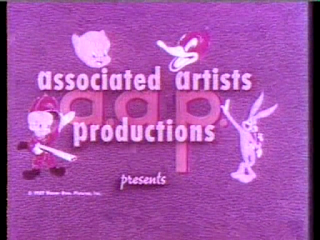
My family didn't get a color TV until 1976, so my earliest views of these, and the classic M-G-M cartoon library, plus Famous Studios, Terrytoons, Walter Lantz and the odd Disney short, were in grainy, low-rez black and white.

As a child, I had no clear idea how old these cartoons were. I knew they preceded my birth, and that the Hanna-Barbera TV cartoons--plus the other contemporary ventures into limited animation that dominated broadcast time--were more recent. No reference books existed, and there was no way to summon up a cartoon at a moment's notice. 

Local TV stations randomly ran their 16 millimeter prints of these films, three to four in a half-hour time slot. Cartoon endings were regularly cut off if the show went into overtime (i.e., exceeded the time alloted to ads). More than once, film broke during a live broadcast. Said cartoon would often next be seen missing a hunk of footage, causing an interruption like a skip on a vinyl record. 

These cartoons were time-fillers to pad out afternoon and wee-hour programming, sell advertising space to (usually) local merchants and give children something to stare at, and thus keep out of trouble/their parents' lives. 

Few people, aside from kids, cared about these broadcasts. The television stations cared about the ads that they packed in-between these shorts. A passing adult might chuckle in remembrance of seeing such cartoon fare in their childhood. And there must have been older animation enthusiasts who had some inkling of knowledge of the art form's history, and who watched these crummy broadcasts as a means to see these elusive films.

That's what I became in my latter years of high school. The golden hours of 3 to 5 PM offered a chance to see x number of cartoons daily--at this time, a mix of Warners, M-G-M and Walter Lantz material, programmed with no rhyme or reason. By then. I'd gleaned first insights behind how these remarkable films came to be--mostly misinformation, but at this time (circa 1978) any info was welcome (if later refuted by proven fact). 

It became easier to connect the dots: William Hanna and Joseph Barbera, producers of so much TV dreck, did those beautifully-animated Tom and Jerry shorts of the 1940s! Animators who worked for Disney also worked for M-G-M, Lantz and Warner Brothers!

One early godsend was the January-February 1975 issue of Film Comment with a large section on classic Hollywood cartoons--a suite of articles that coalesced with the critical thinking I'd begun about these films. The discovery of this issue, in 1979, gave me a sense of purpose in my interest in animation. These were films worth thinking about and studying. They weren't expressly made for children. They had value as containers of American popular culture and history.

Monday, March 26, 2018

Circus Today: Okay, okay! (with guest commentator Devon Baxter)

Release date: 6/22/1940 (according to BCDb)
DVD-Blu-Ray Availability: NONE


You may view the complete version of this cartoon HERE. It has some audio garbage at the start; apologies for the watermarks.

Dailymotion has been acting up lately, but this is the only extant online version I could find (that didn't seem suspicious)...

<><><><><><><><><><>

It may come as a shock to some of you to see a new post here. People have been inquiring about about when I'll be doing the next post on this blog. I'm flattered to know there are folks out there who anticipate reading my two cents on the early works of Tex Avery. Thank you.

Well, since I have a reward in the next cartoon after this, and since my old chum Devon Baxter (whose weekly column on the Cartoon Research website you are reading, aren't you? Hmmm?) offered some guest-commentator notes, I'll saddle up the old bronc and get through yet another Avery unit spot-gag cartoon.

Circus Today is one of the better efforts in this vein--there aren't many spots where I gag--and has some compelling in-jokes. Well, leave us get started...    

No narrator! This cartoon opens with an effective use of sound and visuals to convey the setting and mood. Don Brodie* gets us in the proper festive spirit as a carnival barker, spiels over this lovely circus artwork...
...and dissolves to the barker drawing a crowd. This is a significant step up from the prior spot-gag cartoons. Though Robert C. Bruce's tolerant, bemused narrative voice works well in the earlier cartoons, it's refreshing to see Avery and his writers having enough confidence to let go of that crutch.

Wednesday, June 8, 2016

Screwball Football: Cavorting Sports Retorts

Release date: 12/16/1939 (according to BCDb)
DVD-Blu-Ray Availability: none


You may view the uncensored version of this cartoon HERE.

More spot gags? As if we have a choice. This one has a welcome looseness, and is less reliant on deliberately stinky puns and other verbal-humor quips.

Thanks to this not being reissued, and thus shorn of its elaborate original titles, we can enjoy an unusual approach, via animated silhouettes. There's a funny gag, and everything:

These credits have more laughs than the entirety of, say, A Day at the Zoo, so this is off to a promising start--despite its being a sports cartoon. Not being a sports person, and finding sports, as-is, already funny, I am prone to groan when an athletic theme dominates an animated film.

Saturday, April 30, 2016

Smile When You Say 'Flounder:' Fresh Fish


Release date:
 11/4/1939 (according to BCDb)
DVD-Blu-Ray Availability: nada

You may view a nice-looking copy of this cartoon (with an embedded logo) HERE.

Perhaps I'm softening, or weakening under the spell of these Avery spot-gag cartoons, but they don't seem as egregious as I anticipated. They can be stale, but it's a deliberate staleness, a reveling in the joy of telling a bad or corny joke.

These aren't Avery's most enjoyable or memorable cartoons, but they do offer evidence of the shreds of progress in his path to becoming the most innovative and well-known non-Disney director of Hollywood cartoons.

The long delay in posting this analysis is due to the temporary misplacement of my set of complete Warner Brothers cartoons from a sudden move this past January. I am happy to say the set has been recovered, and I'll try to get through the rest of this spot-gag period quickly and painlessly.

By the time of Fresh Fish, an easy formula rules the Avery-directed spot gag cartoons. Robert C. Bruce is the affable, mildly sarcastic emcee; Mel Blanc and Carl Stalling supply invaluable audio input, and a talent pool of animators with a growing skillset turn out stable, functionial-to-impressive work. The Warners cartoons begin to have the vibe of a finely-tuned machine: each part does its work with due diligence, and each part works with its neighbors in concert.

The lone variant, by this time, is the content of each cartoon. Avery's time at the Leon Schlesinger studios demonstrates the power of this variant. With good material, Avery and crew could create an instant classic cartoon. With formula stuff or a flawed basic theme, the same group of talented people, capable of far greater things, could turn out a trifle. No one was going to remember these things, so if they turned out good, great; if not, well, let's try to make the next one better.

Thursday, January 14, 2016

Detouring America: Gagging (in both senses of the word) Across the Great 48

Release date: 8/26/1939 (according to BCDb)
DVD-Blu-Ray Availability: as an extra on the WHV DVD of Each Dawn I Die


You may view the uncensored version of this cartoon HERE.

Another early spot-gag cartoon, spoofing the abundance of over-narrated travelogues that crowded the short subject segment of motion picture programs.

This format has not grown completely stale, but these spot-gag cartoons have none of the impact they had on first release.

A corny opening "disclaimer," backed by a characteristic medley of familiar national tunes, sets the stage for the next seven minutes and change:
The announcer (Avery regular Robert Bruce) tells us we're going on "an educational tour of the United States." Snort. Chortle. Our first stop is a faux-multiplane Manhattan.

Friday, September 25, 2015

Believe it or Else: The Spot-Gag Syndrome

Release date: 6/3/1939 (according to BCDb)
DVD-Blu-Ray Availability:
 None

You may view this cartoon HERE.

We now enter a troubling period of Mr. Avery's cartoon career. For the next three years, he and his unit will hopscotch between inspired, sometimes-brilliant narrative comedies and topical spot-gag revues.

Many of the latter have not aged well. The best of them (Detouring America and Cross Country Detours) transcend the format's limits with solid comedy and formal experimentation. Too many of the spot-gag pictures are simply lazy work. It's not a matter of elderly gags and worn-out punchlines--it's a lack of dedication that makes these cartoons among the lowest points of Tex Avery's career.

He still had great passion and enthusiasm in his work--as seen in nearly all the non-spot gag cartoons from here on. The shifts from these cartoons--such as our last study, Thugs with Dirty Mugs--to the largely mediocre spot-gag entries is jarring.

Why Avery chose to do these pictures is obvious: they were easy. Having spent himself on a cartoon like Thugs or A Wild Hare (1940), these spot-gaggers were a way to recharge his batteries while keeping product on-schedule. None of the directors at Leon Schlesinger's studio had time to stop and reflect. A set number of cartoons had to be delivered to theaters in every year's schedule.

The format was an innovation of the Avery unit, and perhaps they felt close to it. With most of these cartoons, the best one can hope for are islands of inspiration in a dull grey sea.

A familiar-yet-unidentifiable* voice greets us, in a soft impression of the panel cartoonist Robert Ripley. Ripley began to make live-action short subjects in 1930. You can see the first one HERE.

Faux-Ripley promises highlights of "many odd and interesting facts from around the world." He encounters an immediate critic:
Elmerhead is more Fudd than Egg at this point. Avery abandoned him as a narrative protagonist after 1938's Johnny Smith and Poker-Huntas. In his growing obsolescence, he, as in A Day at the Zoo, is little more than a straw man. He has little reason to be on-screen.

Sunday, August 16, 2015

Thugs With Dirty Mugs: An Avery Masterpiece-- And a Staggering Strangulation of the Gangster Genre

Release date: 5/6/1939 (according to BCDb)
DVD-Blu-Ray Availability:
 Looney Tunes Golden Collection Vol. Three (WHV)

You may view this cartoon HERE. (Warning--the volume control on Critical Commons videos is hidden--it's on the right side of the screen. It only appears if your mouse/finger lingers over it. Take a moment to find the volume slider:this one is LOUD!)

A stellar example of what the Fred Avery unit could produce, when inspiration and skill intersected, this cartoon is one of the director's early masterpieces. It's also a study in economy, with sequences that avoid animation and thus allow its new footage to shine with special effects and expressive, elaborate draftsmanship.

A parody of Warner Brothers' genre-defining gangster and crime movies--a staple of the late-Depression movie-going experience--was a solid idea. By spring of 1939, audiences had viewed over a decade's worth of talkie crime movies. Warners had a big one coming in the fall of 1939--The Roaring Twenties, which co-starred established James Cagney and brink-of-stardom Humphrey Bogart.

Some of these films, like Rouben Mamoulian's City Streets and Edward L. Cahn's Afraid To Talk, are impressive, moody and still of great interest. Much of the Warners/First National efforts are solid entertainments, although given to formula by the middle of the 1930s.

Long story short: this genre demanded a meta-spoof, and Avery gave it to his audience. From music to montage to atmosphere, Thugs With Dirty Mugs is both an effective satire of the gangster film and a formal romp through the biases of Hollywood movie-making.

As would a typical WB picture, we begin with "credits" that show the main characters, culled from apropos footage seen again later in the film. Other cartoons had done this gag, including Avery's, but the device sets up a delicious anticipation--and leaves no doubts as to its coming attractions:*
The screen shots are from the gorgeous restored version seen on the second disc of Warner Home Video's Looney Tunes Golden Collection III. The vibrancy of these restorations makes the viewer wish all the important early Avery cartoons had been given this royal treatment.

Thursday, March 5, 2015

The Isle of Pingo Pongo: Avery Creates Cartoon Tsunami; Inspires Countless Imitations

RELEASE DATE: May 28, 1938 (according to BCDb)
DVD-BluRay AVAILABILITY: none
You can download and view an uncut reissue version of this cartoon HERE.

Fred Avery marked his 25th cartoon 'anniversary' at Leon Schlesinger's studio with a short that sent shock waves through the film industry--and not just the animation world.

It also led to a depressing low point in his early career, as almost a dozen sequels to this innovative film bring his creativity to a screeching halt at the close of the 1930s.

Neither Avery or his audience could have foreseen this grim result in the late spring of 1938. At that time, this cartoon had more shock value and carpet-yanking surprise than any film in his career to date. Avery and credited storyman George Manuell (according to this recently-unearthed original title card) struck a raw nerve in live-action cliches--one that floored its first audiences.

By this time, Lowell Thomas' Going Places shorts had offered filmgoers three years' worth of oft-patronizing mini-tours of far away locales, anchored in the news commentator's relentless narration. Alas, none of these shorts are currently available for viewing on the web, to make a study of Avery's satire more complete. Suffice to say that the films' purple-prose narration and condescending examination of other cultures were an established film trope, by 1938, and thus ripe for savaging.

As with many of the Avery unit's early triumphs at Schlesinger, this cartoon suffers from over-familiarity. Its gently sarcastic tone was wholly absorbed into Hollywood film-making, and cast a large shadow over much film comedy to come.

This cartoon has been off the air since at least 1968, as one of the infamous "Censored 11." It contains a great deal of iffy racist humor, for which more sensitive readers and viewers are hereby advised. No Leonard Maltin apology here; this is just the way it was in late 1930s America. The cartoon was unaltered for a 1944 reissue--late in the game for such insensitive portrayals of non-Caucasian peoples.

That the cartoon is still funny and somewhat fresh is a pleasant surprise. Perhaps this is because it hasn't had the chance to be played to death on TV or home video (although versions exist on various VHS tapes and digital discs).

Saturday, February 21, 2015

Antarctic Creatures Frolic in Art-Deco Style in Pleasantly Plot-free Penguin Parade


RELEASE DATE: April 23, 1938 (according to the Big Cartoon Database)
DVD/BLU-RAY AVAILABILITY:
none at presentAn adequate version of this cartoon may be viewed HERE.

The cartoons of the Fred Avery unit at Leon Schlesinger's studio were, by 1938, among the plottiest animated shorts in Hollywood. Avery's rejection of the Walt Disney ethos included a strong belief in the power of a persuasive narrative.


Not for him was the plotless pageantry of Disney's Silly Symphonies, which did stress narratives, as the 1930s progressed, but often lost themselves in an ooh-aah tableaux format. (They will begin to show an Avery influence in this year--irony duly noted.)

As we've often groused here before, Disney's high-gloss, all-technique-no-soul policy had a negative effect on the American animated cartoon--particularly after 1935, when most animation studios produced upscale color films. With the emphasis away from character, story and, of course, HUMOR, mid-'30s American animation is a dismal low point for the popular art form.

Avery was the Disney Way's fiercest, most vocal opponent. Unlike many critics, he had a counter-offer that he took into action. Through the two dozen cartoons we've perused here, to date, we see Avery's persistent vision sometimes compromised by the front office, but always in evidence. In the weakest of his early cartoons, as in his milestone films, Avery strives to cram as much narrative as coherence will allow. They may have often been dumb storylines, but they followed through, and left the viewer with the sense that they'd seen SOMETHING, no matter how ill-advised.

Sunday, January 4, 2015

The Sneezing Weasel: Takin' Care of Business, Cartoon-Style


RELEASE DATE: March 12, 1938 (according to the Big Cartoon Database)
DVD/BLU-RAY AVAILABILITY:
none at present

You can watch this cartoon  HERE. Enjoy!


1938 is the year Warner Brothers' cartoons begin to feel like Warner Brothers cartoons. All the key players were present--including some who would depart (Friz Freleng, Frank Tashlin) then return in stronger form.

In the meantime, cartoons had to be made, and a yearly schedule fulfilled. Our hero, Fred "Tex" Avery, continues his pattern of a breakthrough cartoon followed by several misfires/near misses. The Sneezing Weasel is one of those also-rans: a warehouse for half-developed concepts that its creator would refine, uplift and transcend in his more acclaimed M-G-M period.

The tentative feel of the mid-1930s Warner cartoons is almost gone. In its place is a brash, cheerful strut. This confidence was sufficient to create the illusion of entertainment, regardless of the content and quality of an individual cartoon. In this same manner, the live-action Warner features bluffed their way into audience's hearts, masking weak narratives and wafer-thin characters with a hearty howzitgoin, mac?

Still coasting on the buzz of Little Red Walking Hood, Avery fashions another minor attack on the wishy-washy cartoons of the day. This film's storyline could have been a Hugh Harman/Rudolph Ising M-G-M animated melodrama. It follows a tiresome cookie-cutter narrative that all the cartoon studios, on both coasts, told to sickening excess in the last half of the decade.

Avery isn't phoning it in here, but he is subsumed by the very weakness he satirizes.

Anyhow, he starts with a reminder that this is NOT a Walt Disney production: 

Friday, June 20, 2014

Egghead Rides Again: A Meh Cartoon Enlivened by Irvin [sic] Spence Animation

RELEASE DATE:
7/17/1937 (according to the Big Cartoon Database; IMDb claims a 11/29/1937 release date)

DVD/BLU-RAY AVAILABILITY:
Kid Galahad DVD (part of WHV's Gangsters Collection, v.4)

You can view a mid-1990s Turner print of this cartoon HERE.

The Avery pattern of major film/minor effort rides again! After the game-changing meta-slap of Uncle Tom's Bungalow, this cartoon seems tame and unexceptional. Cheerful, yes. Mildly amusing, for certain. But it's unworthy of Avery and his unit.

The chief joy of Egghead Rides Again is Irv Spence's charming, eccentric animation. His work both looks back and ahead. His drawing style is redolent of the spiky, kinetic look of Ub Iwerks' mid-1930s cartoons. The apparent influence of Grim Natwick informs Spence's way of drawing.

Wednesday, May 29, 2013

Porky The Rainmaker: Cause-and-effect Comedy in Stark Black and White

RELEASE DATE:
8/1/1936

DVD/BLU-RAY AVAILABILITY:
Porky Pig 101 (WHV 5-dvd set)

You can watch a 1990s-era colorized print of this cartoon HERE. If you're not familiar with this cartoon, please watch before you read--thanks!

After the status symbol of having directed three color cartoons in a row, the Fred Avery unit went back to black-and-white for the Avery unit.

This is not one of Avery's greatest cartoons. It does introduce a couple of important comedic tools to its maker's belt.